
At some point, we probably need to stop acting surprised when BYU is good. The Cougars won 12 games in 2025, reached the Big 12 Championship Game for the first time and finished the season by beating Georgia Tech in the Pop-Tarts Bowl. Instead of disappearing after the breakthrough, Kalani Sitake’s team has opened 2026 with four more wins and climbed to No. 8 in the country.
The latest one wasn’t particularly pretty. BYU went to TCU, played through miserable weather, produced only 216 yards of offense and still walked out of Fort Worth with a 17-10 victory. Bear Bachmeier scored both Cougar touchdowns on the ground, the defense piled up four sacks and BYU improved to 4-0 for the third consecutive season.
Now things get really interesting. Iowa State comes to Provo on Friday night, Notre Dame arrives the following week, the Holy War is waiting in November and BYU once again has legitimate reasons to think about the Big 12 Championship.
This guide is about that team, but it’s also about actually finding the Cougars on television. BYU’s move into the Big 12 changed the viewing landscape considerably from the independent years, and games can now move between ESPN, FOX, TNT Sports and streaming platforms depending on the week.
Already know the Cougars and just need help watching away from home? Jump to our BYU football VPN guide for help with blackouts, geo-restrictions and travel.
BYU Doesn’t Feel Like a Surprise Anymore
The 2024 season was supposed to be a pleasant surprise. BYU won 11 games in its second year as a Big 12 member and showed that the transition from independence wasn’t going to require years of rebuilding.
Then the Cougars got better. BYU went 12-2 in 2025, reached its first Big 12 Championship Game and put together one of the best seasons in program history. That made 2026 an interesting test because it’s one thing to make an unexpected run; it’s another to reload when the rest of the conference already knows what you can do.
Four games into the season, BYU is answering that challenge pretty well. The Cougars beat Utah Tech to start the year before handling a good Arizona team 28-17 in the Big 12 opener. They then went to Colorado State and piled up 559 yards in a 41-23 win before surviving the completely different kind of game they encountered at TCU.
That’s probably what I like most about this start. BYU hasn’t needed every game to look the same. The Cougars can score, run the football and, when conditions make offense miserable, lean on their defense and survive. A team that can win several different ways tends to become a problem in November.
Bear Bachmeier Has Grown Up Quickly
BYU has produced enough quarterbacks over the years that taking over the position comes with a little more history than it does at most schools. Bear Bachmeier doesn’t look bothered by it. After taking over the offense as a freshman in 2025, Bachmeier helped lead BYU all the way to the Big 12 Championship Game. Now a sophomore and one of the team’s captains, he’s no longer simply the young quarterback everyone is waiting to develop. He’s the guy running a nationally ranked team.
The Arizona game showed what his arm can do. Bachmeier threw for 217 yards and three touchdowns while adding another score on the ground in BYU’s 28-17 victory. Against TCU, the conditions took most of the passing game away, so he became the runner BYU needed instead, leading the Cougars with 66 rushing yards and scoring twice.
That second performance won’t produce many Heisman highlight packages, but it might tell us more about him. BYU needed somebody to make a play late in an ugly road conference game, and Bachmeier broke free for a 21-yard touchdown that gave the Cougars enough separation to finish it. For a program with this much quarterback history, that’s a pretty good way to earn some respect.
LJ Martin Gives BYU Something Its Famous Quarterbacks Didn’t Always Have
BYU’s football identity was built around throwing the ball. We’ll get to Jim McMahon, Steve Young and Ty Detmer later because you can’t tell this program’s story without them.
The current team, though, can be downright mean on the ground. LJ Martin entered 2026 as one of BYU’s senior leaders and the reigning Big 12 Offensive Player of the Year. At 6-foot-2 and 225 pounds, he gives the Cougars a physical running back who can take pressure off Bachmeier and punish a defense that gets too focused on the quarterback.
We saw just how destructive that can become against Colorado State. Martin ran for 173 yards and three touchdowns in the first half alone, finishing with 176 yards on only 15 carries. That performance moved him into sixth place on BYU’s career rushing list.
His early exit against TCU is something to watch going forward, particularly with Iowa State and Notre Dame coming up. BYU managed to survive without him for most of that game, but this offense is considerably more difficult to defend when Bachmeier and Martin are both threats to run.
The Cougars have spent decades making defensive coordinators worry about the quarterback. It’s fun seeing them add a bruising running game to the equation.
This Defense Is Giving BYU Room to Have Bad Days
The TCU game is probably the best argument for taking BYU seriously. Not because the Cougars played especially well offensively. They didn’t. BYU managed only 216 total yards and 66 passing yards, while Martin left early. Plenty of ranked teams lose when a road conference game turns into that kind of mess.
The defense made sure BYU didn’t. The Cougars recorded four sacks, Faletau Satuala returned an interception 59 yards to set up BYU’s first touchdown and the defense kept TCU from ever taking control. Tausili Akana, Nusi Taumoepeau, Braxton Lindsay and Jake Clifton all contributed sacks.
That’s where players such as Isaiah Glasker, Keanu Tanuvasa, Cade Uluave, Evan Johnson and Satuala become so important. BYU’s offense is going to have better nights than it did in Fort Worth, but championship contenders eventually encounter a Saturday where nothing works properly.
Good teams find a way out anyway. BYU has become unusually comfortable doing that. The TCU victory improved the Cougars to 9-2 in one-score games over the last three seasons.
Friday Night Against Iowa State Suddenly Matters a Lot
BYU doesn’t have to wait long for its next test.
Iowa State visits LaVell Edwards Stadium on Friday, October 9, with kickoff scheduled for 8:15 p.m. Mountain Time on ESPN.
The Cougars finally broke through against Iowa State last season after losing the first five meetings in the series. That victory was memorable because BYU fell behind 24-10 before closing the game on a 31-3 run and winning 41-27 in Ames.
This year’s meeting comes with a different kind of pressure. BYU is undefeated, ranked in the Top 10 and knows exactly what’s coming one week later. Notre Dame.
That’s why Iowa State has all the ingredients of a dangerous game. It’s a conference matchup against a capable opponent sitting immediately before one of the most anticipated home games on BYU’s schedule. Take care of Iowa State, though, and Provo is going to be absolutely ready for October 17.
Notre Dame Coming to Provo Feels Like a BYU Game From Another Era
I love this matchup because BYU and Notre Dame are two programs that don’t fit neatly into the same box as everybody else. For years, both were major independents willing to build national schedules rather than simply follow a conference slate. BYU eventually joined the Big 12, while Notre Dame has maintained its football independence.
Now they’re meeting in Provo. Notre Dame visits LaVell Edwards Stadium on October 17, its first trip there since 2004. BYU won that previous game in Provo 20-17, while Notre Dame won the most recent meeting between the programs 28-20 in Las Vegas in 2022.
It’s also an important measuring stick. BYU can prove plenty by winning Big 12 games, but beating Notre Dame would carry a different kind of national weight. If the Cougars enter that Saturday undefeated, this stops being merely a fun nonconference game. It becomes one of the biggest BYU home games in years.
Where Can You Watch BYU Football in 2026?
The answer changes from week to week, which is one of the biggest differences between following BYU now and following the Cougars during much of the independence era.
As a member of the Big 12, BYU games can be distributed across the conference’s television partners, including ESPN, FOX and TNT Sports, along with associated streaming platforms. Network assignments depend on the matchup and television window.
For example, the Utah Tech opener streamed on ESPN+, while the upcoming Iowa State game is scheduled for ESPN. Bigger matchups later in the season can move into different national television windows.
The best method is simple: check BYU’s official schedule during game week rather than assuming the Cougars will be on the same network they used the previous Saturday.
That becomes especially important for games like Notre Dame, Utah and any matchup that could affect the Big 12 race late in the season.
Can You Stream BYU Football Without Cable?
Yes. In fact, BYU fans have been streaming football for a long time. The important thing in 2026 is making sure your service actually carries the network assigned to that particular game. A live-TV streaming package with the relevant ESPN, FOX or other Big 12 television channels can replace a traditional cable subscription, while some games can be placed directly on streaming platforms such as ESPN+.
Just remember that ESPN+ is not the same thing as ESPN. Having an ESPN+ subscription doesn’t automatically provide access to a game being televised on the main ESPN network.
BYU also offers radio coverage through BYU Radio, which remains a useful option when you can’t watch the game or simply want the Cougar broadcast while traveling.
LaVell Edwards Stadium Has One of College Football’s Best Backdrops
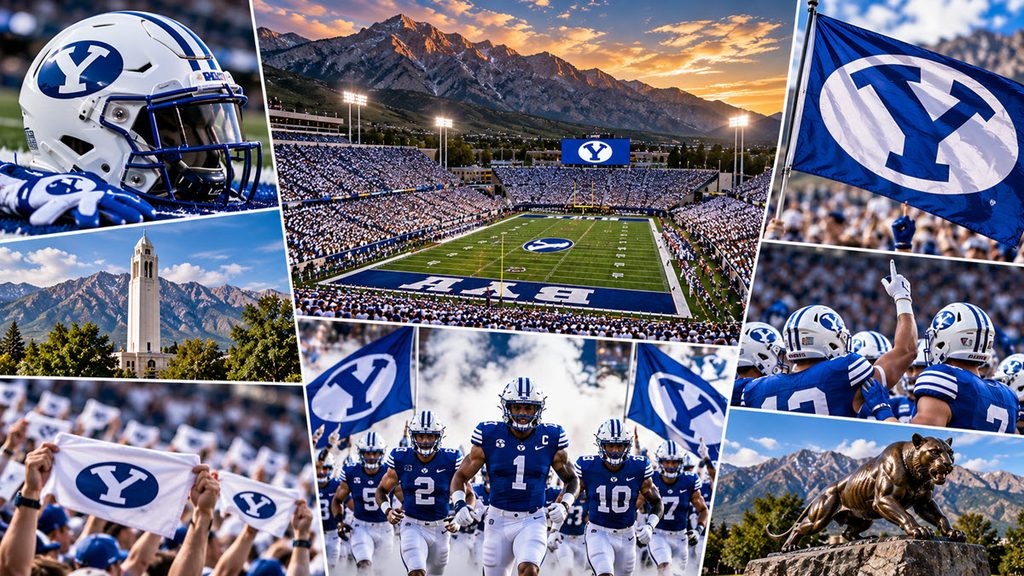
There are bigger stadiums in college football. There aren’t many prettier ones. LaVell Edwards Stadium seats 62,073 fans in Provo, with the Wasatch Mountains rising behind the stadium and giving BYU home games a setting that’s immediately recognizable on television. The stadium opened as Cougar Stadium in 1964 and was renamed for LaVell Edwards when the legendary coach retired after the 2000 season.
The student section, known as The ROC, has helped turn that scenery into a genuine home-field advantage. BYU even points to a 2021 game against ranked Arizona State when the crowd contributed to four consecutive false starts.
Game day starts well before kickoff, too. Cougar Walk brings fans around Cougar Boulevard as the team arrives, while food, music and other activities build around the stadium.
It’s a different atmosphere from Neyland, Williams-Brice or the Horseshoe, which is exactly why I think it’s worth emphasizing on a BYU page. College football is better when each stadium feels like its own place. Provo definitely does.
BYU’s Football Identity Was Built Through the Air
If there’s one historical section that belongs in every serious BYU football article, it’s the quarterbacks.
LaVell Edwards took over a program in 1972 that had never been to a bowl game and transformed it with an aggressive passing offense. During his 29 seasons, BYU won 19 conference championships, reached 22 bowls and eventually captured the 1984 national championship.
The quarterbacks became the program’s calling card. Jim McMahon won the first Davey O’Brien National Quarterback Award in 1981. Steve Young won it in 1983 while finishing second in the Heisman Trophy voting. Robbie Bosco led BYU to the national championship in 1984.
Then came Ty Detmer. Detmer threw for 5,188 yards and 41 touchdowns in 1990, led BYU to a famous 28-21 upset of No. 1 Miami and became the first Cougar to win the Heisman Trophy. He eventually finished his BYU career with more than 15,000 passing yards.
That lineage is why quarterback play carries a little extra weight in Provo. Bachmeier doesn’t need to become Detmer or Young to have a great career, but every successful BYU quarterback becomes part of a tradition that helped change how college football was played.
The 1984 National Championship Still Makes BYU Different
BYU isn’t simply a program with a couple of great seasons and famous quarterbacks. The Cougars have a national championship. The 1984 BYU team went undefeated, finishing the job by defeating Michigan in the Holiday Bowl and earning the program’s first national title. Robbie Bosco led the offense, and LaVell Edwards completed a transformation that would have seemed almost impossible when he took over 12 years earlier.
The championship remains one of the most distinctive achievements in modern college football history because BYU didn’t come from one of the sport’s traditional power conferences. The Cougars built a national reputation through an innovative offense, an ambitious schedule and a generation of quarterbacks who kept rewriting passing records. That history matters again now.
Joining the Big 12 gives BYU a much clearer path to competing for conference championships and College Football Playoff access than it had during the independent years. The Cougars no longer need to convince everyone that an unconventional national schedule should be enough. They can win their conference and settle the argument on the field.
Independence Helped Make BYU a National Program
BYU spent 2011 through 2022 as an FBS independent, and while conference membership is better suited to the current playoff landscape, I don’t think that period should be treated like some awkward gap between conferences.
Independence reinforced something that had been true for decades: BYU’s fan base doesn’t stop at Utah. The Cougars scheduled games all over the country, developed a national television presence and regularly played in front of BYU fans hundreds or thousands of miles from Provo. That national reach also fits the university itself, whose alumni and supporters are spread far beyond the Mountain West.
The Big 12 move changed the weekly stakes. Now BYU has a conference race, championship game and a regular collection of opponents that can develop into new rivalries.
But the national identity didn’t disappear. That’s part of what makes a home game against Notre Dame feel so appropriate. It’s a little reminder of the version of BYU football that existed before the Big 12.
The Rest of BYU’s Schedule Leaves Almost No Time to Relax
The upcoming stretch is what will determine whether BYU’s 4-0 start becomes another excellent season or something even bigger.
First comes Iowa State on October 9, followed immediately by Notre Dame on October 17. BYU then travels across the country to play UCF in Orlando before returning home for Arizona State.
November begins with the Holy War at Utah. Baylor then comes to Provo before BYU travels to Kansas and closes the regular season against Cincinnati at LaVell Edwards Stadium.
There’s no single stretch where I look at the schedule and think the Cougars can simply coast for a month. But that’s also the opportunity.
How to Watch BYU Football With a VPN
BYU’s national fan base makes the travel side of streaming particularly relevant. Streaming services can use your IP address and other location information to determine what content you’re allowed to access. If you’re traveling outside your normal region—or outside the United States entirely—you can sometimes discover that the service you use to watch BYU at home has changed what it makes available.
That’s where a VPN can help when geography is specifically causing the problem.
A VPN routes your internet connection through a server in another location, changing the IP address visible to websites and streaming platforms. It can be useful for location-based restrictions, regional availability issues and some sports blackouts.
How to Unblock a BYU Football Stream
- Choose a VPN. We recommend ExpressVPN for sports streaming.
- Connect to an appropriate VPN server location.
- Check which network or service is carrying the BYU game.
- Sign into the streaming service you normally use for that broadcaster.
- Reload the stream and watch the Cougars.

Affiliate Disclosure: VPNForSports may earn a commission if you purchase through links on this page, at no additional cost to you.
That third step matters. A VPN doesn’t provide an ESPN subscription, and connecting to a server won’t make an ESPN+ game suddenly appear on FOX. You still need legitimate access to the service carrying the game.
The VPN becomes useful when your location is the reason that service isn’t working as expected.
BYU Might Be One of the Better College Football VPN Use Cases
I wouldn’t say that about every team.
BYU is a little different because Cougar fans are spread around the country and internationally. Add a Big 12 schedule that sends the team from Utah to places like Texas, Florida and Kansas, plus BYU’s history of national scheduling, and there are plenty of fans trying to follow the Cougars far away from Provo.
Travel is where a VPN makes the most sense. If you’re outside your normal viewing region for Iowa State, Notre Dame or the Holy War and discover your usual stream is unavailable because of location, connecting through an appropriate VPN server can help.
It can also encrypt your internet connection when you’re watching over hotel, airport or other public Wi-Fi.
VPNForSports recommends ExpressVPN because of its server network, device support and straightforward apps.
[Get ExpressVPN for BYU Football]
Just start by checking the broadcaster. Location isn’t always the problem, and there’s no reason to troubleshoot a blackout when you’ve simply opened the wrong streaming service.
Maybe BYU Has Already Answered the Question
Before the season, it was fair to wonder whether BYU could repeat what it accomplished in 2025. Four games haven’t answered everything. Iowa State hasn’t arrived yet. Notre Dame hasn’t walked into LaVell Edwards Stadium. The Cougars still have to go to Utah, and the Big 12 has enough parity to punish anyone who starts looking too far ahead.
But I’m starting to think “Can BYU do it again?” might already be the wrong question. This program has won 11 games, followed it with 12 wins and now started another season 4-0. Bachmeier is only a sophomore. Martin gives the offense a legitimate star in the backfield. The defense just proved it can drag BYU through an ugly road game when almost nothing works offensively.
That’s starting to look less like a surprising run and more like what Kalani Sitake has built. BYU has spent much of its history doing things differently anyway. LaVell Edwards turned a program that had never reached a bowl into a national champion. The Cougars produced a parade of quarterbacks when most of college football wasn’t throwing the ball that way. They spent more than a decade as an independent and then jumped into the Big 12 without needing much time to become a contender.
Now they’re No. 8 in the country with Iowa State and Notre Dame coming to Provo in consecutive weeks. We don’t need to decide yet how far this team can go. But I think we’re past being surprised that BYU is here.