Miami fans have spent a long time hearing the same question: Is The U back? After 2025, I think we’re finally allowed to ask a better one. Can Miami finish the job?
The Hurricanes went 13-3 and all the way to the national championship game last season, beating Texas A&M, defending national champion Ohio State and Ole Miss in the College Football Playoff before falling 27-21 to Indiana. For a program that measures itself against five national championships, getting close isn’t the same as hanging another banner. But for the first time in a long time, Miami football felt like it belonged at the center of the national championship conversation again.
Now comes the fun part. Mario Cristobal has to prove that wasn’t a one-season peak. The 2026 schedule isn’t going to make that easy. Clemson is waiting in October. Florida State comes to Hard Rock Stadium. Notre Dame gets Miami in South Bend in November. There are important players to replace, new Hurricanes who need to emerge and an entire season to determine whether last year’s playoff run represented Miami’s return or merely a great year.
That’s what we’re digging into here: the team, the history behind The U, the players who could determine what happens next and where you can watch and stream Miami Hurricanes football throughout 2026.
Already have the football part covered? Jump straight to how to use a VPN for Miami Hurricanes football for help with blackouts, geo-restrictions and watching while traveling.
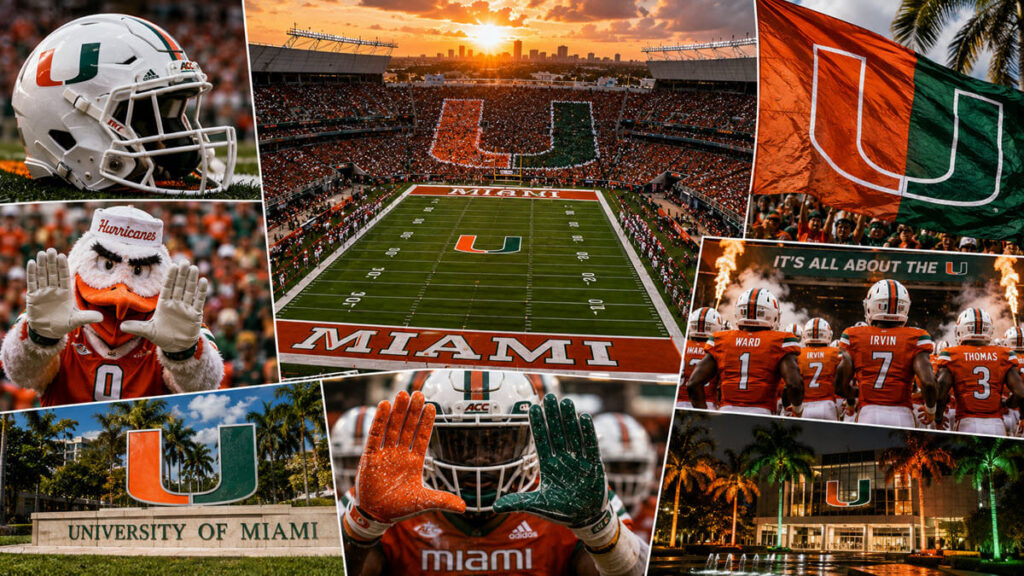
Miami Got Close. Really Close.
It’s easy to look at 13-3 and remember the three. That would miss what Miami actually accomplished. The Hurricanes entered the College Football Playoff as the No. 10 seed and immediately found themselves in a defensive fight at Texas A&M. Miami survived 10-3 to advance. Then came Ohio State.
The Buckeyes were the defending national champions, and Miami beat them 24-14 in the Cotton Bowl. Ole Miss was next in the Fiesta Bowl semifinal, where the Hurricanes won 31-27 and earned a trip to the national championship game. The destination made the whole thing even more interesting. The championship was being played at Hard Rock Stadium.
Miami had fought its way through the playoff only to arrive back at its own home stadium with a chance to win national championship No. 6. Indiana led 10-0 at halftime, but Miami didn’t disappear. The Hurricanes kept fighting back and eventually got the football with a chance to win late in the fourth quarter. The comeback ended with an interception near the Indiana goal line, allowing the Hoosiers to escape Miami with a 27-21 victory.
That’s a painful ending if you’re a Canes fan. It’s also a pretty convincing answer to anyone wondering whether Miami was actually capable of competing with the best teams in the country. The question in 2026 isn’t whether Miami can get there. We just watched them do it.
Mario Cristobal Came Home for This
Mario Cristobal isn’t just another coach who happened to take the Miami job. He played offensive tackle for the Hurricanes from 1989 through 1992, winning national championships with Miami in 1989 and 1991. He knows exactly what the program looks like when it’s operating at the level Miami fans expect.
That made his return as head coach in 2022 especially interesting. It also made the early struggles more frustrating. Miami went 5-7 in Cristobal’s first season and 7-6 in his second. The Hurricanes improved to 10-3 in 2024 before finally breaking through in 2025 with 13 wins, their first College Football Playoff appearance and a trip to the national championship game.
That’s a substantial progression. Cristobal didn’t arrive in Coral Gables and instantly recreate the Miami teams he played for. It took roster building, recruiting, transfers and some painful Saturdays along the way. Now the standard changes. A 10-win season can no longer be presented as proof that the rebuild is working. Miami just played for the national championship. The next step is figuring out how to get back.
The Quarterback Changes, but Miami Isn’t Starting Over
Carson Beck was a major part of Miami’s run in 2025. He arrived from Georgia for his final college season and helped take the Hurricanes farther than any Miami quarterback had in decades. Beck threw for more than 3,500 yards and 29 touchdowns while guiding the offense through the ACC schedule and eventually into the CFP championship game.
Now Miami has to replace him. That naturally puts attention on the 2026 quarterback room, but I don’t think the Hurricanes’ season should be reduced to one position. One of the reasons Miami is intriguing again is the amount of talent Cristobal has assembled around whoever takes the snaps. The quarterback won’t be asked to make The U relevant. Miami already did that last year. He’ll be asked to keep it there.
Here’s the Part That Should Excite Canes Fans
Miami still has playmakers. Malachi Toney became one of the most exciting young pieces of the 2025 team and enters 2026 with an opportunity to become an even bigger part of the offense. He’s the kind of player who fits what fans have always wanted Miami football to look like: dangerous in space, capable of creating explosive plays and difficult to forget once the ball reaches his hands.
Then there’s the backfield. Mark Fletcher Jr. gives Miami an experienced running back, while Jordan Lyle and Girard Pringle Jr. add more talent to the room. Pringle arrived at Miami as one of the most highly regarded running backs in his recruiting class and gives the Hurricanes another young player capable of forcing his way into a larger role.
The receiving group also includes Joshua Moore and other young players competing for opportunities around Toney. That’s where the 2026 offense gets interesting. Miami doesn’t need every young player to become a superstar. But if two or three of them take a significant step forward at the same time, the Hurricanes could once again have the type of speed and depth that makes defending them uncomfortable. And when you’re talking about Miami football, speed matters.
What Is “Miami Football” Supposed to Look Like Anyway?
This is where Miami is different from almost every other program we’re covering. Notre Dame has independence and tradition. Tennessee has generations of history built around Neyland Stadium. Indiana is living through something completely new. Miami built its reputation differently. Swagger. Speed. South Florida talent. NFL players everywhere. And absolutely no requirement that the rest of college football had to like them.
That’s the image people still associate with The U. It wasn’t inevitable. Miami didn’t begin college football as a permanent national powerhouse. The program existed for decades before the Hurricanes suddenly transformed into one of the defining teams in the sport. A huge part of that transformation started with Howard Schnellenberger.
Howard Schnellenberger Saw What Miami Could Become
When Howard Schnellenberger took over Miami in 1979, he inherited a program that had struggled for years and wasn’t remotely viewed the way younger fans would eventually view The U. Schnellenberger saw something different.
South Florida was producing enormous amounts of football talent. Instead of watching those players leave for programs around the country, Miami could build its roster around keeping more of them close to home. That vision eventually produced the breakthrough.
On January 2, 1984, Miami faced No. 1 Nebraska in the Orange Bowl. Nebraska entered as the dominant team and a favorite to win the national championship. Miami won 31-30. Nebraska attempted a two-point conversion late rather than settling for a tie, and Miami stopped it. The Hurricanes had their first national championship. College football in Miami was never quite the same again.
Then Miami Became The U
Schnellenberger left after the championship, but Miami didn’t disappear. Jimmy Johnson took over and pushed the program’s personality even further. The Hurricanes were fast, aggressive, talented and increasingly comfortable playing the villain when the rest of college football treated them like one. Miami won another national championship in 1987. Dennis Erickson followed Johnson and won championships in 1989 and 1991. Then came 2001.
Five national championships in less than two decades:
1983.
1987.
1989.
1991.
2001.
That’s why Miami’s expectations can seem absurdly high from the outside. For fans who watched The U at its peak, national contention wasn’t some fantasy about what Miami might eventually become. They’d already seen it happen repeatedly.
Pick Your Era, Miami Had Somebody
Trying to make a short list of great Miami players gets ridiculous quickly. Start at quarterback and you can find Jim Kelly, Bernie Kosar and Vinny Testaverde. Move outside and there’s Michael Irvin. Defense? How much time do you have? Ray Lewis. Ed Reed. Warren Sapp. Sean Taylor. Then there are players like Andre Johnson, Frank Gore, Clinton Portis, Edgerrin James, Reggie Wayne and Jeremy Shockey.
Miami’s official football history includes dozens of first-round NFL Draft picks and a remarkable collection of players who went on to become professional stars. But I think the names matter for another reason. They created an identity that Miami has spent the past two decades being compared against. When people say they want “The U” back, they’re not simply asking Miami to win nine games. They’re remembering rosters where future NFL stars seemed to be standing everywhere.
The 2001 Hurricanes Still Cast a Very Long Shadow
Every great Miami team eventually gets compared with 2001. That’s not particularly fair. It also probably isn’t going to stop. The 2001 Miami Hurricanes went 12-0 and won the national championship, finishing the season by beating Nebraska 37-14 in the Rose Bowl. The roster was absurd.
Ken Dorsey was the quarterback. Clinton Portis and Frank Gore were in the backfield. Andre Johnson and Reggie Wayne were among the receivers. Jeremy Shockey and Kellen Winslow II were at tight end. Bryant McKinnie was on the offensive line. The defense included Ed Reed, Jonathan Vilma, Phillip Buchanon, Mike Rumph, D.J. Williams and Vince Wilfork. And that’s still not everybody.
That’s the standard hanging over modern Miami football. The Hurricanes haven’t won another national championship since. Which is precisely why 2025 mattered so much. Miami finally got back to the final game.
Where Can You Watch Miami Hurricanes Football in 2026?
Watching Miami in 2026 will require a little more attention than simply opening the same channel every Saturday. The Hurricanes begin the season on Friday, September 4 at Stanford, with the game scheduled for 9 p.m. ET on ESPN.
Miami then returns home to face Florida A&M on September 10 at 8 p.m. on ACC Network. The Hurricanes go back on the road against Wake Forest on September 18 for another ESPN game before hosting Central Michigan on September 26 at 6:30 p.m. on The CW. That’s ESPN, ACC Network and The CW within the first four weeks. Welcome to watching ACC football.
Miami games throughout the season can appear across the ACC’s broadcast partners, including ABC and the ESPN family of networks, ACC Network and The CW. Exact assignments for many later games are announced closer to kickoff. The simplest rule for Canes fans is to check the individual game’s network before Saturday. Don’t assume the service that had Miami last week will have them again.
Can You Stream Miami Football Without Cable?
Yes. The service you’ll need depends on where the game is being broadcast. Live-TV streaming packages carrying ESPN, ABC, ACC Network and The CW can cover many Miami games, although channel availability varies between services and locations. The first month illustrates why this matters.
A streaming package with ESPN might cover Stanford and Wake Forest, but Miami’s Florida A&M game is on ACC Network. Central Michigan then moves to The CW. Later national games could appear on ABC or other ESPN networks. If you’re primarily subscribing to watch Miami, look at the upcoming schedule rather than choosing a service based on one Saturday.
Can You Watch Miami Football Through Miami Athletics?
Miami Athletics provides plenty of Hurricanes content online, including schedules, news, interviews, press conferences, highlights and other team programming. That’s useful if you follow the Canes throughout the week. It doesn’t replace the network broadcasting the live football game.
If Miami is playing on ESPN, you’ll need appropriate ESPN access. The same applies when a game lands on ACC Network, ABC, The CW or another broadcast partner. Think of Miami’s official platforms as the place to follow the team. The broadcast partner is where you watch the game.
Hard Rock Stadium Is Not Your Typical College Football Stadium
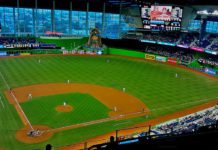
Miami’s home-field situation has always made the Hurricanes a little different. The Canes don’t play in a traditional on-campus stadium surrounded by dorms and academic buildings. Since 2008, Miami has played its home games at Hard Rock Stadium in Miami Gardens. It’s also home to the Miami Dolphins. And the Miami Open. And the Formula 1 Miami Grand Prix complex. It hosts major soccer matches, concerts and some of the biggest sporting events in the country. That’s very Miami.
There is something slightly surreal about a college football program with five national championships playing in the same building that can host an NFL game, international soccer and Formula 1 festivities. Then 2025 added another layer. Miami fought through the College Football Playoff and earned a spot in the national championship game. The championship just happened to be scheduled at Hard Rock Stadium.
The Hurricanes essentially played the biggest game of their season at home. They came six points short. If Miami eventually wins championship No. 6 under Cristobal, that night is going to remain one of the biggest “what if?” moments of this era.
The Old Orange Bowl Is Still Part of Miami Football
Hard Rock Stadium is Miami’s home now. But you can’t really talk about The U without talking about the Orange Bowl. The old Miami Orange Bowl was where much of the program’s reputation was built. It was loud, imperfect, intimidating and deeply connected to the great Hurricanes teams of the 1980s, 1990s and early 2000s.
Miami once won 58 consecutive home games there from 1985 through 1994. Think about that. An entire graduating class could have gone through Miami without seeing the Hurricanes lose a home football game. The Orange Bowl was demolished after Miami moved out, so today’s Hurricanes can’t recreate that environment exactly. They don’t need to. The challenge is making Hard Rock Stadium feel like the home of this Miami era rather than constantly trying to recreate somebody else’s.
Florida State Week Is Still Florida State Week
Miami’s national ambitions may have returned, but some things don’t need to be reinvented. Florida State comes to Hard Rock Stadium on October 17. Miami is planning an Orange Out for the game, and it’s difficult to imagine Canes fans needing much additional motivation. Miami-Florida State has produced national championship consequences, missed kicks, NFL stars and enough bizarre endings to fill an article by itself. Wide Right. Wide Left. The names alone are enough for longtime fans.
The rivalry also represents something bigger about football in Florida. Miami, Florida State and Florida have spent decades fighting over many of the same recruits and the same claim to being the state’s premier program. When all three are good, college football in Florida gets considerably more interesting. For Miami, beating Florida State also matters regardless of what the playoff rankings say. Some games are about the postseason. Some are about living with the people around you for the next 12 months.
Notre Dame and Miami Still Have Some Bad Blood
Then there’s Notre Dame. Miami travels to South Bend on November 7, giving the Hurricanes one of their most interesting road games of the season. Younger fans may simply see two national brands meeting in November. Older fans know better. The Miami-Notre Dame rivalry reached its nastiest point during the 1980s, when both programs were national championship contenders and neither side was particularly interested in hiding its dislike for the other.
The infamous “Catholics vs. Convicts” phrase surrounding the 1988 game didn’t come from Notre Dame or Miami, but it became permanently attached to the rivalry. Notre Dame won that game 31-30 and eventually captured the national championship. Miami got revenge one year later, beating No. 1 Notre Dame 27-10 on the way to its own national championship. That’s the kind of history sitting underneath the November 7 game. And if both programs are still in the playoff hunt by then, the modern version won’t need much help feeling important.
How to Watch Miami Football With a VPN
Miami fans are used to worrying about the opponent. Fans traveling on Saturday can occasionally have another problem: the location screen.
Streaming services can use your IP address and other location information to determine which content you’re allowed to access. If you’re traveling outside your normal viewing region, the Miami stream you typically use can sometimes become unavailable because of a blackout, geo-restriction or another location-based limitation.
A VPN changes the IP address visible to websites and streaming services by routing your connection through a server in another location. If location is specifically what’s preventing your normal Miami Hurricanes stream from loading, a VPN can help.
How to Unblock a Miami Hurricanes Stream
- Choose a VPN. We recommends ExpressVPN for sports streaming.
- Connect to an appropriate VPN server location.
- Check which network is broadcasting the Miami game.
- Open your existing streaming service and sign in.
- Reload the Hurricanes stream.

Affiliate Disclosure: VPNForSports may earn a commission if you purchase through links on this page, at
The network check in Step 3 matters. A VPN won’t turn an ACC Network game into an ESPN game or provide a subscription you don’t have. If you’re looking in the wrong place, changing your IP location isn’t going to solve anything.
Where a VPN becomes useful is when geography is actually the problem. It can also encrypt your connection, which provides additional privacy when you’re watching the Canes over hotel, airport or other public Wi-Fi while traveling.
Miami’s Season Comes in Three Acts
Some schedules are easier to understand if you pick five big games. Miami’s 2026 schedule makes more sense as a story.
Act I: Don’t Give Away September
Miami opens at Stanford before returning home for Florida A&M. Then comes another ACC road trip to Wake Forest followed by Central Michigan at Hard Rock. The Hurricanes should have bigger goals than simply surviving September, but early-season road games can get weird. Miami also has players settling into new roles after a long 2025 playoff run. If the Canes want another championship opportunity, September is about avoiding the kind of loss that makes everything harder later. Because October isn’t friendly.
Act II: Welcome to October
October 3: at Clemson. That’s how the month starts. Miami then gets a bye before Florida State comes to Hard Rock on October 17. Pittsburgh visits one week later before the Hurricanes finish October at North Carolina. That’s Clemson, Florida State, Pittsburgh and North Carolina in four consecutive games with one bye mixed in. This is where we’ll learn quite a bit about the 2026 Hurricanes. Clemson gives Miami a major road test immediately. Florida State brings the rivalry pressure. Pittsburgh and North Carolina make sure there’s no opportunity to mentally check out afterward. If Miami gets through October in playoff position, start paying attention.
Act III: The Playoff Push
Then Miami goes to Notre Dame. The November 7 game in South Bend could become one of the biggest games on the national schedule if both programs are where they expect to be. Miami then finishes with Duke and Virginia Tech at home before traveling to Boston College on November 28. By that point, there won’t be any need to ask whether the Hurricanes are contenders. We’ll know.
Miami’s 1991 Champions Are Coming Back
There’s another reason the September 26 Central Michigan game is worth noting. Miami is celebrating the 35th anniversary of its undefeated 1991 national championship team. That team went 12-0 under Dennis Erickson and captured Miami’s fourth national championship. It featured players such as Gino Torretta, Kevin Williams, Micheal Barrow and Darrin Smith and represented the Hurricanes at the height of their original run.
Now those champions are returning while another Miami team is trying to finish what the 2025 Hurricanes nearly accomplished. I love that kind of college football connection. The 1991 team doesn’t need to be treated like museum history. Those players are coming back to watch the current Hurricanes play. And the current group knows exactly what trophy they’re chasing.
When Does a VPN Make Sense for a Canes Fan?
You don’t need a VPN simply because Miami is playing football. The clearest use case is travel. Suppose you’re outside your normal viewing area when Miami plays Florida State. Maybe you’re overseas during Notre Dame weekend or traveling for work when the Hurricanes have a game on ACC Network.
If your normal streaming service changes what’s available because of your physical location, a VPN can help by changing the IP location visible to that service. That’s where Miami football VPN and unblock Miami Hurricanes searches actually connect to a real problem rather than simply becoming keywords stuffed into an article.
We recommend ExpressVPN for sports streaming because of its server selection, device support and straightforward apps.
Affiliate Disclosure: VPNForSports may earn a commission if you purchase through links on this page, at no additional cost to you.
Check the broadcaster first. If you have the right service and location is what’s stopping you, then troubleshoot the geographic restriction.
So…Is The U Back?
I think we can finally retire the version of this question that gets asked every time Miami starts 4-0. Miami doesn’t need another September winning streak to prove it’s relevant. The Hurricanes just played for the national championship.
They beat Texas A&M. They eliminated the defending national champion Buckeyes. They survived Ole Miss. They made it all the way back to Hard Rock Stadium with a chance to win No. 6 and had the football late in the fourth quarter.
Indiana stopped them. That hurts. It also changes what comes next. The Miami of Michael Irvin, Ray Lewis, Ed Reed and the Orange Bowl isn’t coming back exactly as it was. It can’t. College football has changed too much. Mario Cristobal’s job is to build the next version.
He’s a former Hurricane who remembers firsthand what Miami looks like when championships are expected. He’s taken the program from 5-7 to the national championship game, and the 2026 roster now gets the difficult assignment of proving that Miami’s return to the national stage wasn’t temporary.
Clemson will test that in October. Florida State will bring all the usual noise to Hard Rock. Notre Dame is waiting in South Bend. And somewhere along the way, we’ll get our answer. Maybe asking whether The U is back is still premature. But after last season, nobody gets to laugh at the question anymore.