
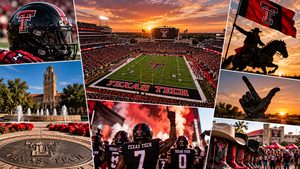
Texas Tech football has always been entertaining, but the Red Raiders are playing for something different these days. After years of being known for explosive offenses, unforgettable upsets and some of the wildest passing statistics in college football, Texas Tech finally captured its first Big 12 championship in 2025. That breakthrough changed expectations in Lubbock, and now Joey McGuire’s program is trying to establish itself as a regular contender rather than a team that occasionally surprises the conference’s traditional powers.
The 2026 season has already provided plenty to discuss. Texas Tech opened with six consecutive victories, including a convincing 53-25 win over Arizona State, before suffering its first defeat at Cincinnati. The Red Raiders enter the final stretch at 6-1 overall and 3-1 in Big 12 play, with Arizona, West Virginia, Oklahoma State, Baylor and TCU still on the schedule.
Whether you’re following the Red Raiders from Lubbock, elsewhere in Texas or outside the United States, finding the right broadcast can be a challenge. Texas Tech games can appear on several different networks, and traveling can introduce additional streaming restrictions.
This guide starts with how to watch Texas Tech football, including streaming without cable and using a VPN for location-related restrictions. Then we’ll get into the football itself, from Will Hammond and the defending Big 12 champions to the Air Raid years, the Masked Rider and what makes a Saturday in Lubbock special.
How to Watch Texas Tech Football With a VPN
Texas Tech has fans across the country, and not everyone gets to spend Saturday afternoons watching the Red Raiders from West Texas. Traveling for work, taking an international vacation or simply being away from your normal viewing region can sometimes make streaming more complicated than expected.
Many sports streaming platforms use your IP address and other location information to determine which broadcasts are available. Depending on the service, a game you can normally watch at home may become unavailable while you’re traveling because of a geo-restriction, regional blackout or another location-based limitation.
A VPN can help when your location is the reason your normal streaming service isn’t working. By routing your connection through a server in another location, a VPN changes the IP address visible to websites and streaming platforms.
Quick Setup: Watching Texas Tech Football With a VPN
- Choose a VPN. VPNForSports recommends ExpressVPN for sports streaming because of its server network, device support and straightforward apps.
- Connect to an appropriate server location. Choose a location relevant to the streaming service you’re trying to access.
- Check the Texas Tech broadcast schedule. Confirm whether the Red Raiders are playing on FOX, ESPN or another network.
- Open your streaming service. Sign into the service you normally use to watch the assigned broadcaster.
- Reload the stream. If location was the problem, the VPN may help restore access.

Affiliate Disclosure: VPNForSports may earn a commission if you purchase through links on this page, at no additional cost to you.
A VPN doesn’t provide a television subscription or change which network owns a broadcast. You’ll still need access to the appropriate streaming service, and VPN compatibility can vary by platform. However, when you’re traveling and geography is specifically causing the problem, a VPN can be a useful addition to your sports streaming setup.
Another benefit is privacy. A VPN encrypts your internet connection, which can be particularly helpful when you’re watching football using hotel, airport or other public Wi-Fi networks.
Where to Stream Texas Tech Football in 2026
Texas Tech competes in the Big 12, meaning its games are distributed through the conference’s television agreements. The primary broadcasters include FOX and ESPN, with games appearing on networks such as FOX, FS1, ESPN and other associated television or streaming services.
The important thing to understand is that Texas Tech doesn’t have one permanent television home. The Red Raiders have already appeared on different networks throughout 2026, and the broadcaster can change depending on the opponent, kickoff window and national television selections.
For example, Texas Tech’s game against Colorado aired on FOX, while other matchups have been assigned to different national broadcasts. With the Red Raiders now regularly competing in nationally relevant games, their television windows can attract considerable attention.
For fans, the simplest approach is to check the official schedule during game week and identify the assigned broadcaster before deciding where to stream.
Can You Watch Texas Tech Football Without Cable?
Yes. A traditional cable subscription isn’t required if you have a live-TV streaming service carrying the network assigned to that week’s game.
Services such as YouTube TV, Hulu + Live TV, Fubo and DIRECTV can provide access to various national sports channels, although availability, subscription packages and channel lineups differ. Some Big 12 games may also be available through dedicated streaming platforms, depending on the broadcast arrangement.
It’s worth checking more than one upcoming game before choosing a service. A package that works for a Saturday afternoon on FOX might not necessarily include every channel Texas Tech will appear on later in the season.
Also remember that ESPN+ and ESPN are different services. An ESPN+ subscription doesn’t automatically provide access to a game airing on ESPN’s traditional television network.
What About Watching Texas Tech Internationally?
International viewers can encounter a different set of challenges because college football broadcast rights aren’t identical around the world. A service available in the United States may offer different programming abroad, while some countries have separate broadcasters carrying selected American college football games.
If you’re traveling internationally, check whether the game has an authorized broadcaster in your destination. If you normally use a streaming service at home and discover that location is preventing access, a VPN may help with certain geographic restrictions.
The key is identifying the actual broadcaster before troubleshooting. A VPN can address some location-related problems, but it cannot supply a subscription or guarantee that a streaming platform will work in every country.
Texas Tech Football Has Entered a Different Era
For a long time, Texas Tech was one of college football’s most dangerous outsiders. The Red Raiders could produce a spectacular offensive performance, knock off a highly ranked opponent and turn Lubbock into one of the loudest places in the Big 12. What they couldn’t quite do was turn those memorable moments into a conference championship.
That finally changed under Joey McGuire.
Texas Tech finished 12-2 in 2025, won the Big 12 Championship Game against BYU and earned a spot in the College Football Playoff. The Red Raiders defeated the Cougars 34-7 in Arlington, capturing their first Big 12 title and their first outright conference championship since 1955.
The season ended with a disappointing Orange Bowl loss to Oregon, but the larger accomplishment shouldn’t be overlooked. Texas Tech had finally done what several generations of talented Red Raider teams couldn’t accomplish: win the conference outright and enter the national championship conversation.
The challenge for 2026 is maintaining that standard. The Red Raiders are no longer simply chasing a breakthrough, and opponents aren’t overlooking a program that just won the Big 12.
A 6-1 Start Has Shown Both Sides of the Red Raiders
Texas Tech opened the season with victories over Abilene Christian, Oregon State, Houston and Sam Houston before heading into conference play’s more demanding stretch. A 29-7 road victory against Colorado showed how effectively the Red Raiders could control a game through defense, while their 53-25 victory over Arizona State demonstrated that the offense could still produce an explosive afternoon.
The Arizona State result was particularly satisfying because the Sun Devils had handed Texas Tech its only regular-season defeat in 2025. Beating them convincingly in Lubbock gave the Red Raiders another reason to believe they could defend their conference championship.
Then came Cincinnati. Texas Tech entered the October 24 matchup undefeated but left Nippert Stadium with a 37-24 loss. The Red Raiders produced 400 yards of offense, but Cincinnati rushed for 255 yards and controlled important portions of the game. Penalties and difficulty converting third downs made the comeback even more challenging.
That defeat doesn’t erase the first six games, but it does change the conversation. Texas Tech has already proven it can dominate opponents. Now the question is how quickly McGuire’s team can respond when the season stops going according to plan.
Will Hammond Doesn’t Have to Be the Next Patrick Mahomes
Playing quarterback at Texas Tech comes with an unusual amount of history. This is the program that produced Graham Harrell, Kliff Kingsbury, B.J. Symons and Patrick Mahomes, so the position will always attract attention from fans who remember the Air Raid’s most entertaining years.
Will Hammond has inherited a different kind of responsibility. Rather than taking over an offense expected to throw for 500 yards every week, he’s leading a program that just won the Big 12 and now expects to compete for another championship.
Hammond had already gained experience before becoming the starter in 2026, although a knee injury interrupted his 2025 season. With Behren Morton no longer leading the offense, Hammond became the quarterback responsible for keeping Texas Tech among the conference’s contenders.
Through seven games, Hammond has thrown for 1,561 yards with six touchdowns and six interceptions, completing nearly 68 percent of his passes. Those numbers reflect a quarterback who has shown promise but still has room to become more consistent, particularly against stronger conference defenses.
The encouraging part is that Texas Tech doesn’t need Hammond to do everything himself. A productive running game and an aggressive defense can keep the Red Raiders competitive even when the passing offense isn’t having its best afternoon.
For a school with Texas Tech’s offensive history, that’s a pretty interesting change.
The Running Game Has Become More Important Than People Realize
Texas Tech’s reputation was built on quarterbacks throwing the football all over the field, but the current Red Raiders are more comfortable using the running game to control possessions.
J’Koby Williams and Quinten Joyner give the offense multiple options out of the backfield. Both can contribute in different situations, allowing Texas Tech to maintain offensive balance instead of relying entirely on Hammond’s passing production.
Williams led the team with 81 rushing yards against Cincinnati, while Joyner has already produced important plays throughout the season, including a long touchdown run against Colorado. Their contributions matter because opposing defenses cannot simply prepare for Texas Tech by dropping extra defenders into coverage.
When the running game is effective, Hammond gets more manageable passing situations and the Red Raiders can control the pace of a game. That becomes especially important during the final month of the season, when opponents have more film and conference matchups tend to become increasingly physical.
Texas Tech can still be explosive, but it no longer needs to play at an exhausting offensive pace to win.
Defense Has Changed What Texas Tech Can Accomplish
One of the biggest reasons Texas Tech won the Big 12 in 2025 was its defense.
The Red Raiders finished that season among the nation’s best defensive teams, leading the FBS with 32 takeaways and allowing fewer than 70 rushing yards per game. Those numbers would have seemed almost unimaginable during some of Texas Tech’s most offense-heavy seasons.
The 2026 defense has continued to produce important moments, even after the departure of several key players from the championship team.
Against Colorado, Texas Tech intercepted four passes and prevented the Buffaloes from scoring after their opening possession. The Red Raiders won comfortably despite an uneven offensive performance, which is exactly the type of game championship contenders need to survive.
The Cincinnati loss showed that the defense isn’t invulnerable. Allowing 255 rushing yards is particularly concerning for a team that built much of its recent identity around controlling the line of scrimmage.
Still, the larger transformation remains significant. Texas Tech has developed a program where defense is an essential part of the winning formula rather than something the offense constantly needs to compensate for.
Why Joey McGuire Fits Texas Tech
Joey McGuire arrived in Lubbock with an unusual background for a major college head coach. Before joining the college ranks, he spent years building a successful high school program at Cedar Hill in Texas, developing a reputation for recruiting relationships, player development and an ability to connect with communities.
Those qualities have become central to his work at Texas Tech.
McGuire has embraced the school’s identity rather than trying to turn the Red Raiders into a copy of another Big 12 program. Texas Tech still celebrates its offensive history and West Texas personality, but the coaching staff has emphasized physical football, recruiting and building a roster capable of competing against nationally ranked opponents.
Winning the Big 12 in 2025 gave that approach its biggest validation.
The next step is sustainability. Texas Tech has the resources, fan support and recent success to remain relevant, but repeating a championship season requires the program to handle expectations, injuries and opponents who now view the Red Raiders as a major target.
That makes the final stretch of 2026 particularly important for McGuire’s long-term project.
The Masked Rider Makes Texas Tech Instantly Recognizable
You don’t need to know much about Texas Tech football to appreciate its most recognizable tradition.
Before home games, the Masked Rider charges onto the field on horseback, dressed in black with a cape and distinctive mask. It’s one of the most dramatic entrances in college football and fits the character of West Texas almost perfectly.
The tradition became official during the 1954 Gator Bowl, when student Joe Kirk Fulton rode onto the field before Texas Tech faced Auburn. The entrance created such a memorable reaction that it eventually became a permanent part of Red Raider football.
Today, the Masked Rider remains one of the university’s most important athletic symbols, appearing at games and other events throughout the year.
It’s a tradition that stands out because it doesn’t feel interchangeable with anything another school does. The combination of the black horse, masked rider and packed stadium immediately tells you where you are.
Lubbock Is a Different Kind of College Football Town
Texas Tech doesn’t have the geographic advantages of some major college football programs. Lubbock sits on the South Plains of West Texas, far from the state’s largest metropolitan areas, and the surrounding landscape feels very different from the campuses of many other Big 12 schools.
That isolation is part of what makes the football atmosphere special.
The Red Raiders are a major source of community identity, and home games bring together students, alumni and fans from across West Texas. The stadium fills with red and black, the Masked Rider leads the entrance and the crowd has a reputation for making life uncomfortable for visiting teams.
Texas Tech’s home stadium, currently carrying the Galaxy Stadium naming rights, has also undergone major improvements and renovations in recent years. Those investments reflect a program that expects to compete at a higher level and wants its facilities to match that ambition.
The home-field results have been impressive. Texas Tech has built a lengthy winning streak in Lubbock, and the atmosphere becomes particularly intense when nationally ranked opponents visit.
For fans watching on television, the setting is part of the appeal. A big Texas Tech home game has its own energy, especially when the Red Raiders start making explosive plays and the crowd gets involved.
The Air Raid Made Texas Tech a National Attraction
Long before Joey McGuire won the Big 12, Mike Leach turned Texas Tech into one of the most entertaining programs in the country.
Leach became head coach in 2000 and introduced an aggressive version of the Air Raid offense that emphasized spreading the field, attacking through the passing game and forcing defenses to cover enormous amounts of space.
Texas Tech quarterbacks began producing statistics that seemed almost impossible at the time. B.J. Symons threw for 5,833 yards in 2003, setting an FBS single-season passing record, while Graham Harrell later surpassed 5,000 yards in consecutive seasons.
The offense also helped develop a national reputation for Texas Tech. Fans who had no particular connection to the university would tune in simply because the Red Raiders might produce a 50-point game or a quarterback could throw for 500 yards.
Leach’s teams weren’t always balanced, but they were rarely boring. His influence extended far beyond Lubbock, helping shape the spread passing offenses that eventually became common throughout college football.
That era remains essential to understanding the program’s identity, even though the current team has adopted a more balanced approach.
The 2008 Texas Game Still Defines an Era
Texas Tech’s 2008 victory over Texas remains one of the most unforgettable moments in Big 12 history.
The Red Raiders entered the matchup undefeated, while Texas arrived in Lubbock ranked No. 1 nationally. The game lived up to its billing, with Texas Tech building an early lead before the Longhorns fought back and moved ahead late in the fourth quarter.
With only seconds remaining, Graham Harrell found Michael Crabtree near the sideline. Crabtree caught the pass, escaped the defenders trying to bring him down and reached the end zone for the winning touchdown.
Texas Tech won 39-33, sending the stadium into celebration and moving the Red Raiders to 9-0.
The play became one of the defining highlights of the Mike Leach era, but the 2008 team was much more than one catch. Harrell and Crabtree formed one of college football’s most dangerous combinations, and Texas Tech climbed as high as No. 2 nationally.
For years, that season represented what Red Raider football could become when everything came together.
The 2025 Big 12 championship finally gave fans another historic team to place alongside it.
Patrick Mahomes Was Doing Ridiculous Things Before the NFL
Patrick Mahomes has become one of the most recognizable quarterbacks in professional football, but Texas Tech fans were watching him make extraordinary plays long before his NFL success.
Mahomes played for the Red Raiders from 2014 through 2016, producing more than 11,000 passing yards and becoming one of the most prolific quarterbacks in program history.
His 2016 game against Oklahoma remains particularly memorable. Mahomes threw for 734 yards and five touchdowns, but Texas Tech still lost 66-59 in a game where neither defense could consistently stop the opposing offense.
That performance captures both the excitement and frustration of the era. Texas Tech could produce incredible offensive statistics while still struggling to win enough games against quality opponents.
The current Red Raiders offer a useful contrast. They don’t need Hammond to throw for 700 yards to compete for championships, and the program’s defensive improvements have made it possible to win games in a completely different way.
The Remaining 2026 Schedule Will Determine Texas Tech’s Ceiling
Texas Tech enters the final five games of the regular season with a 6-1 record, meaning the Big 12 race is still very much alive despite the loss at Cincinnati.
The next opportunity comes on October 31 against Arizona in Lubbock, with kickoff scheduled for 11 a.m. Central Time. It’s an important chance for the Red Raiders to respond at home before entering November.
West Virginia visits on November 7, giving Texas Tech another home conference matchup before the schedule shifts to two consecutive road games.
The Red Raiders travel to Oklahoma State on November 14 and Baylor on November 21. Both games carry potential conference implications, and the Oklahoma State matchup has an additional connection because the Cowboys are coached by former Texas Tech player and assistant Eric Morris.
Texas Tech then returns to Lubbock for the regular-season finale against TCU on Thanksgiving night.
The schedule gives the Red Raiders opportunities to rebuild momentum, but there’s little room for another disappointing performance if they want to return to the Big 12 Championship Game.
Thanksgiving Night Against TCU Is a Fitting Finale
Texas Tech closes the regular season against TCU on Thursday, November 26, at 7 p.m. Central Time.
The matchup is known as the Battle for the Saddle, and the rivalry has become an important part of the Red Raiders’ Big 12 schedule.
The Thanksgiving setting makes this year’s meeting particularly interesting. College football already occupies much of the holiday weekend, but Texas Tech hosting a conference rival on Thursday night creates a different atmosphere from the usual Saturday finale.
Depending on how the previous four games unfold, the TCU matchup could carry major consequences for the Big 12 standings and Texas Tech’s postseason opportunities.
It also provides one more chance for the Red Raiders to finish the regular season in front of their home crowd, which has become a meaningful advantage during the McGuire era.
Texas Tech Has More to Prove, and That’s a Good Thing
Texas Tech’s 2025 championship changed what success looks like in Lubbock. The Red Raiders have moved beyond simply hoping to upset a conference contender and are now trying to become the program other teams measure themselves against.
That doesn’t mean the process will be smooth. The Cincinnati loss was a reminder that even a talented defending champion can struggle on the road, particularly when turnovers, penalties and defensive breakdowns begin to accumulate.
But there’s still plenty to like about this team. Hammond has shown he can lead a productive offense, the running game provides balance and the defense remains capable of taking over a matchup. McGuire has also demonstrated that he can recruit and build a roster suited to winning in the modern Big 12.
For longtime Texas Tech fans, the contrast with the Air Raid era is fascinating. The Red Raiders still have the same identity, traditions and appetite for explosive football, but they’re no longer dependent on scoring 50 points to beat quality opponents.
The next five games will tell us whether Texas Tech can recover from its first defeat and put itself back in the championship race. Arizona, West Virginia, Oklahoma State, Baylor and TCU each present different challenges, and another trip to Arlington will have to be earned.
Whatever happens, the standard in Lubbock has changed. Texas Tech isn’t simply looking for another memorable Saturday anymore. It’s trying to build a program where championship seasons become something fans can reasonably expect.